Yesterday was a banner day for me. I finished two projects on the same day! To celebrate, I am sharing this project only on this blog. I've hinted at it on Instagram recently, but if you follow me on Instagram, you really haven't seen this project yet.
 |
| The Easy Tool Rack. |
This is a
fantastic project that Christopher Schwarz came up with a while back for Popular Woodworking's I Can Do That series. It looks good, is a useful piece of shop furniture, and is dead-simple to make if you follow Chris' instructions.
Of course I need to do this, and of course I need to make it unnecessarily complicated.
 |
| First, let's go get some wood. On the bus. |
This is a good-sized project that will test the work holding I have available to me. Plus, I don't have a pocket-hole jig, and I am using only my set of hand tools.
I think I want to cut a notch in the back of the side pieces and nail the back board directly onto the sides from the back, and I want a through, wedged mortise and tenon for the front rail. I'll think about how to attach the top later.
 |
| My bowsaw does a good enough job roughing out the shape of the sides. |
The string on my bowsaw broke as I was getting ready to make this cut, so I had to run to the 2 Euro store to get some more string. I came home with some nylon cord that seems to work just fine. It's yellow with red in it. You know, because Spain.
In the hope of keeping these posts from getting too annoyingly long, I have figured out how to make GIF images, so hopefully you can see a little mini-slideshow of what I'm doing.
Once the shape was roughed out for the side pieces, I wanted to make them as close to perfectly the same as possible. I figured the easiest way to do that was to clamp them together and use spokeshaves to bring them down. My flat spokeshaves did a great job on the flat and convex parts, and I had to bring out a front-to-back curved spokeshave for the concave part.
I finished off the very bottom of the supports by marking the roundover with a coin, cutting a 45 degree piece off with my saw, and rasping it to final shape.
Once they were the same, I used a side-to-side curved spokeshave to put a gentle profile on it. Unfortunately this spokshave wouldn't touch the concave parts, but I do have a scraper I made a while back that happens to have the same profile.
 |
| A mini-slideshow showing the shaping of the side supports. |
I really liked the feel of this slight roundover. It is gently enough of a curve that you really don't notice it from a distance, but it really feels nice to the touch. I liked it so much, I decided to do this treatment to all of the exposed edges on this piece, except the flat parts of the tool holders.
 |
| After adding a chamfer to the top shelf, I added the roundover to the edge. |
Next it's time to work on the front tool support.
 |
| I ripped the tool support to width. |
There was a problem when I crosscut to length. A cavity, similar to something you might run into with plywood!
 |
| There's really no way to prevent this. |
This edge was going to be exposed, as it was intended to be the end of a through tenon. I decided that since I didn't know how much I would lose when I cut it shorter, that I would change the design instead. Rather than doing a through mortise and tenon, I would do a 1/4" stopped mortise and tenon, and use Roman nails to secure them.
I had a bit of a difficult time planing the faces of these boards, but it was easy to get them smooth with a card scraper.
 |
| This pine scraped smooth just fine. |
Christopher Schwarz used store-bought Shaker pegs for his rack, so I figured I would do the same. I couldn't really find anything I liked, but I did find some super cheap coat racks that had nice-enough looking pegs on them. I bought two and hoped I would get something I could use.
Luckily, they were just sloppily glued in place. All eight pegs came out with just a little bit of twisting with my hands. I feel sorry for whoever buys these things expecting to use them to actually hold something. I'm sure the pegs would pop out after a short time of light use.
It was a quick matter to clean them up by scraping the PVA glue off of them. They were unfinished, so they only needed some sanding.
To mount them to my rack I drilled a stopped 10mm hole in the parts I had marked with a pair of dividers. After that, I used a smaller bit to go all the way through. A little hide glue and a screw from the back hold these pegs securely. And I mean, securely. These pegs aren't coming off without destroying something on this piece.
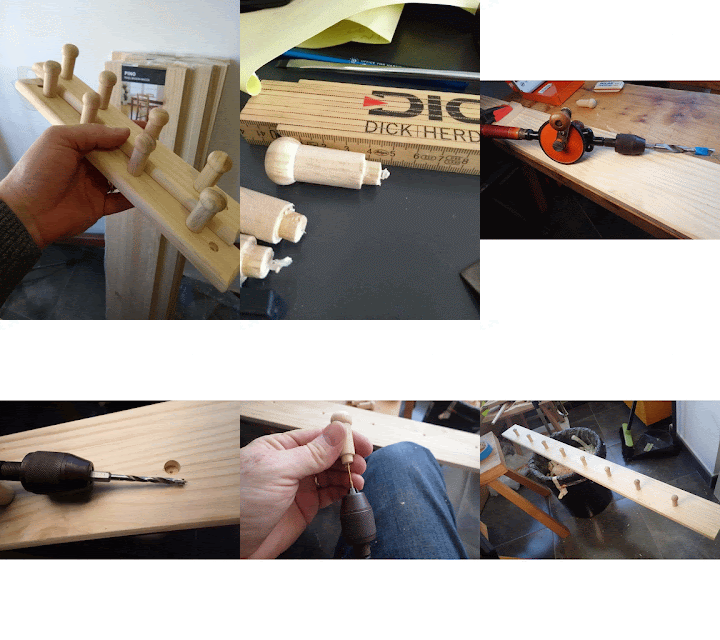 |
| Here's another mini-slideshow documenting the mounting of the pegs. |
After that it was time to move my attention to the stopped mortises. It's not so much a mortise and tenon as I housed the ends of the boards. I did try something new on this one: Charles Hayward said a good way to rough out stopped rabbets is with a gouge. I figured I'd try it, and it worked great. There was only a little to remove with the routing plane using this technique.
 |
| Yet another GIF showing the routing of the mortises. |
That's about it. It's really starting to look like a shelf now.
 |
| Mocked up, it is looking good. |
Overall, I would have to say the lesson here is that it's OK to change the plan for your joinery to suit your tool set, as well as the materials you have to work with.
Next up, milk paint.


