Friday, May 15, 2026

Shekere Build - Part II

In the last post I documented how I obtained the gourd for my shekere (which is an African instrument that I intend to use with my salsa band), cleaned and prepared the outer surface.

Today I need to cut the top off, clean out the inside, dress the opening and hopefully get the first coat of finish on it.

Here are the tools I think I'll need:

Tools to finish the shekere after cleaning and preparing the outer surface.
I need painter's tape to prevent tear-out. I really have no idea if this is necessary, as I've never used a saw on a pumpkin before, but it is what I would do if it were wood. The rubber band is to mark a line in the place where I would like to cut it. And of course, my trusty Dick saw. I could have used any old hand saw, but I really do love writing about the Dick saw.

My apologies if you've never been to this blog before to hear about the infamous Dick saw. It is just a Gyokucho brand Japanese saw that was white-labeled for the Dictum tool company. For some reason they used to use Dick as the brand name of their own tools, to the delight of woodworkers in the English speaking world. Unfortunately I don't think they sell Dick tools anymore, only their tools with the Dictum name. It's probably my fault.

Anyway...

Here is what I did with the rubber band:

Using a rubber band for layout.
I tried to line up the rubber band with the widest part of the top bulb of this pumpkin. It doesn't have to be perfect. If I wasn't documenting this for posterity, I probably would skip this step and just eye-ball the cut. There is no need for it to be straight.

Once I was happy with the rubber band, I used a fine Sharpie to trace my line around the gourd.

I traced the line of the rubber band with a Sharpie.
This actually gave a relatively even line that completely circled the top bulb. If you do this, just take your time making the rubber band as straight and even as you can.

Work holding is not so easy with a giant gourd. I used some old rags to make a little nest for it on the balcony floor. This actually worked very well, as the gourd could be held securely, and rotated with ease.

Off with it's head!
The crosscut teeth on the Dick saw left a surface that only needed a little effort to clean up with sandpaper.

I kept the top of the gourd, because I had intended to do some chip carving to the outer edge of the gourd, and to somehow stain the inside of the neck black. The cutoff would have been ideal to practice on. In the end, I decided the gourd itself was plenty beautiful on it's own, and ornaments aren't really needed. 

I wasn't sure what to expect inside of this gourd, as the lady in the YouTube video that I watched said it smelled disgusting, and cleaning out the mucky, damp, rotting mess inside was not a fun job.

This gourd was perfectly dried, and the inside smelled just like the outside, without the dirt.

It turns out I needed a kitchen spoon to help remove all the guts.
Here is where I was glad this pumpkin was so big. I'm not so sure how easy it would be to clean out the guts of a gourd if a hand couldn't be run inside to do the dirty work.
The inside is now empty-ish.
I experimented to do the rest of the cleanup of the gourd. Sandpaper worked well to even out the saw marks.
Using sandpaper with a block to erase the saw marks.
The inside of the neck was pretty rough, so I used a half-round rasp to do the dirty work, and finished it off with sandpaper. Finally, I used sandpaper to round over the edges a bit, as they were pretty sharp.
Using my beloved Logier rasp to clean out the inside of the neck.
The last thing I did with the gourd today is apply some finish. I am starting with some of my homemade boiled linseed oil (this stuff is so beautiful to work with), but the smelly store bought stuff would work just as well.
The gourd carcass with finish on it.

I might put on another coat after it cures. Maybe not. And then a coat of shellac for protection and a bit of sheen. Then it will be ready for beads.

I think the bottom turned out where I added the epoxy. It's a natural product, so I don't mind.

Next time, I will hopefully be documenting how easy and smooth adding the beaded lattice net will be to build.

Thursday, May 14, 2026

Shekere Build - Part I

Oh, my. 

I see it's been five years since I last posted to this blog.

Time flies.

I've not disappeared, but it is true I haven't been doing much woodworking. Instead, I've been using my spare time playing trombone with some salsa bands here in Munich. Lots of fun.

My perspective from a recent Salsa gig.
However, I think it's time for me to start building again. What better way than to make an instrument I'll use on stage? A shekere!
My new shekere and güiro.
I recently bought a second hand shekere from a local percussionist. The one I bought is mass-produced (but quality), and made from fiberglass, but I decided I needed to try to make my own using a gourd, which is what how this instrument is traditionally made.

I watched several videos on YouTube, and found this one by the Stanford Taiko channel to be the most helpful.

I started by searching online for dried gourds for sale, and surprisingly found a seller in Germany. I ordered from the largest category of gourd they sell, hoping one would arrive that is nearly as big as the fiberglass one from LP.
My new gourd.
I was very pleased when it arrived. It was even bigger than I had hoped.

The first step was to clean it up in the sink with a metal pot scrubber. This task did not smell very nice, and it was probably a good thing that I did this while The Frau was at work.
Cleaning the gourd in the kitchen sink.
After it was clean and dry, I used 120 and 180 grit sandpaper to finish the cleanup.
Clean and finish sanded to 180 grit.
Being a natural product, there were some defects in the base of the gourd. I'd describe it as tear out. I don't think it affects the integrity of the gourd, but it doesn't look so nice, and you can really feel it. 
Some natural defects.
I decided to do what I would do with wood that has such defects: I mixed up some West Systems epoxy, added a drop of some brown color that I had laying around, with the thought that I would sand it flush and all would be good.
Dried epoxy on the affected area.

My Crucible card scraper was great for rough removal of epoxy.

It doesn't look that great, but it is smooth and hopefully stronger.
I'm wondering if clear epoxy wouldn't have been a better choice. Only time will tell. 
Braiding some string for the collar.
Next I thought it was time to start thinking about the net and the beads. I am going to use some 1mm polyester thread that I use for leatherwork for the net. I thought the collar on the top and on the bottom should be a bit thicker, so instead of using para-cord, I decided to braid three different colored strings for these parts. I don't see why this won't work just fine, and the contrasting colors are the exact color scheme as the beads.
I'll use these plastic 8mm beads.
Salsa Roja is the name of my salsa band, so there has to be some red in this gourd. I'll add black and some fake pearls for interest.

Next I have to saw off the top of the gourd, clean out the inside, add some finish to the gourd, and create the bead lattice. 

It's a big gourd, I hope 1800 beads are enough.

Stay tuned....

Monday, April 12, 2021

The Case for Inches and Fractions

Or, Fraction Math Without a Calculator!

Buckle up!

I recently was watching a tutorial video from a well-known and very talented leather maker on layout and design. It was painful for me to watch. Not because he wasn't a good teacher, but because of how he was struggling with his method for measuring distances and dividing those distances in two.

He did what many of us would now first think to do: he measured the distance between two points in inches and fractions, he converted the fractions into decimals using a table he printed out so he could input those fractions into his calculator, made his calculations and then used his table again to re-convert those decimals back into fractions so he could find the new measurements on his ruler.

Those of you who do all of your measuring in the metric system are laughing about now.

There are so many ways to screw up calculations in the above scenario that one really needs to be careful.

First, I suggest don't measure at all, if you can. Use dividers to make your measurements and transfer them directly. No math, no figuring. If you need to divide those distances you've measured, there are easy ways to do it that have been around thousands of years. Others have covered this, and I suggest looking these ways up because they are foolproof and involve no measuring, measurement systems, or math. In other words, it's foolproof: no mistakes.

If you insist on measuring with a tape, ruler, measuring stick, etc. (and I know you do), don't blow off the imperial measuring system just because dealing with 10s is sometimes easier.

What if you need to divide 293 milimeters by two? Likely you can do that in your head, but there is still a tiny bit of guesswork involved.

Inches were born for this. As an example, let's take the above situation with the leather worker. He measured his leather and found it to be four and a quarter (4¼) inches long. So far, so good. 

What he did was convert 4¼ into 4.25 so he could put it in his calculator. He divided this number by two to find the midpoint, and the calculator told him the midpoint was at 2.125 inches.

Out came his trusty piece of paper with a table on it telling him that 0.125 inches is ⅛ inch. Add two and his midpoint is two and one-eighth inches.

For the love of God! Did no one learn fractions in the third grade?

Here's how dividing 4¼ should be done (in your head):

divide the whole number: 4/2=2. This is easy because the number is even, we don't have to do anything else to it.

Look at the fraction - ignore the top number and double the bottom number: ¼ becomes ⅛.

2⅛ inches. Done.

Let's try another measurement from my own leather project: four and seven eighths (4⅞) inches:

Half of the whole number: 4/2=2.

Ignore the top number of the fraction and double the bottom: ⅞ becomes 7/16.

Half of 4⅞ is 2 7/16.

One more example from my current project: seven and three eighths (7⅜) inches.

Half of the whole number: 7/2=2.5. Woops! If the whole number is odd, this doesn't work. What do we do? 

Don't panic.

Take the next lower even number. In this case, six. 6/2=3.

That extra whole number needs to go to the fraction. Add the bottom number of your fraction to the top, and that is your new top number. In our example, ⅜ becomes 11/8 when we add eight to the top number, three.

We're not done yet. We have an inch added to our original fraction. We need to find half of this new fraction. Same as before, just double the bottom number. 8*2=16. Our new fraction is 11/16.

Add it all up, and our midpoint for 7⅜ inches is three and eleven sixteenths (3 11/16).

Here are a few common measurements for you to practice. Write down the answers before you look at the answer key.

Find the midpoint:

  • 11½
  • 5⅝

Here are the answers (no cheating!):

  • four and three eighths
  • five and three quarters
  • two and thirteen sixteenths
Easy, right? Let me know your method.

Wednesday, December 30, 2020

Flooring Dutch Tool Chest - Part VII - Finished! (for now)

Ta-daaaaa!
We left off having painted and BLO'd the chest. I normally finish off an oiled finish with some type of paste wax. My favorite is one that I make myself from beeswax, orange oil, and a few other goodies. I happen to have all of my paste wax ingredients in Spain, not in Germany where I am at the moment. After digging around, however, I found some Howard's Feed-N-Wax This has beeswax and orange oil in it, so I thought I'd give it a try.
 
Feed-N-Wax

The consistency of this product is a little more liquid-y than what I make. It seemed to work well, though, and it is very easy to apply this way. What I did was squirt a glob in the middle of a cloth, wrap the cloth around it, and use the cloth as an applicator. After letting it sit for 10-15 minutes, I buff it out with a clean cloth.

I like the look.

Now that the finish is done, let's get rid of those ugly drywall screws and replace them with roman nails. Unfortunately the only Roman nails I happened to have are 60mm long, about 2 1/2" or so. Total overkill for this, but it's what I have.

Out with the old...
In with the new!

This engineered hardwood is much more fragile than solid 3/4" pine, so I had to be very careful. Most of the screws I backed out left a hole big enough that I could push the nail in with finger pressure until less of an inch of the nail was sticking out.

Notice a Roman nail makes a good hammer handle wedge.

It's just then a matter of carefully tapping the nail home.

But not too far!

I've learned the hard way that if you keep banging on these nails, the head will crush the wood fibers around it, spoiling a nice paint job. One only needs to tap until the sound changes. I check it is deep enough if I'm unable to get a fingernail under the head of the nail.

One minor blowout.

There were only two nails that decided to misbehave. One is pictured above, it blew out on the underside of the center shelf. It's not too bad, and it's in a hidden place, so I left it be. The other was on a corner with a dovetail. Remember, I reinforced my dovetails with nails, and I think this reinforcing nail pushed my Roman nail out of the way. While I was tapping it home, I noticed it started to come out of the bottom of the chest. Since I still had  little way to go with the nail, I decided to remove the nail and squirt some PVA glue in the wood that was deforming. I then nipped an inch of length off the nail with some nippers, and pounded the nail in. Good as new.

My method of clenching nails in a single photo.

I decided to attach the battens on the fall front with clenched nails. I really like this technique. It holds forever, like it or not.

Now I can say I'm done with the carcass of the chest. Here's some glamour shots:

There's obviously a bit more to do, such as organize the top compartment to hold my leather working tools, add some handles on the sides, and maybe a lock. I might also decide to make another matching box for this one to sit on that is on casters. That would give me even more storage for stuff I didn't need that often, as well as making it easily transportable around my apartment.

Overall I'm extremely happy with this chest. I didn't really have high expectations for it. In fact, I figured it would be something that perhaps I would throw out someday and build again when I had better materials. But this box is surprisingly strong. 

Someone asked about the weight. I'm not a very good judge, but I think it is probably similar to a chest made of pine. This one as it is weighs 13.4 kilograms ( about 30 pounds). Not too bad for a huge box. 

The single best part of this chest for me is the finish. I toyed with the idea of turning the beech side out, but I figured the joints would bee too ugly and weird. I'm glad I chose this. I am stunned at how well those Japanese burnishers prepared the soft underside of the flooring material for milk paint. Sadly, it can't be properly displayed in photos. I find myself running my hands over the surface of the lid every time I walk by it.

The milk paint turned out so well, that I'm wondering what else I could make and finish this way. It just dawned on me that my ATC that I built in 2011 is still unpainted. Perhaps it would be fun to try red over black?

I look forward to many years of use from this tool chest. I hope you enjoyed the build half as much as I did.

Tuesday, December 29, 2020

Flooring Dutch Tool Chest - Part VI

 Paint.

This chest is nearly done.

Just like any other project, the quality of the finish depends greatly on surface preparation. In this case, I spent a lot of time with my Japanese burnishers in order to get a specific texture on the wood that I wanted to show through the milk paint. 

I chose milk paint because it is a traditional look for tool chests, plus it is pretty easy and safe to use.

The brand of milk paint mix I use is Old Fashioned Milk Paint. There are others, but this is the one I know best. I used some home-made milk paint on the last chest I made, and I have to say this mix is much easier and more consistent. Perhaps I need to work on my home-made recipe a little.

Anyway, for quite some time I've really admired the black over red look that is often seen on Windsor chairs. Curtis Buchanan has some really great YouTube videos on how he makes his, and in one of them he goes over his method for achieving the look he gets with this finish. If you would like to watch it, search "Curtis Buchanan - 46. Preparing to Paint" on YouTube.

I've tried this before, and haven't really gotten the results I was looking for. This time I tried to do everything the same exact way he does, and I'm very pleased.

The first bit that I took away from his video, is the water to milk paint ratio he uses. For red, he uses a 2:1 ratio, and for black he uses a 2.5/1 ratio.

Barn red basecoat.

The other thing I may have done wrong in the past was apply too-thick coats. This time it worked well to use just a little paint on the brush, and drag it as far as can be done. I spent some real time trying to avoid runs, as those will show through in the end.

After two coats of red, I let it rest over Christmas and moved onto the black.
Black over the red.
With the black, I also didn't worry about applying it in thick coats. This is more of a wash coat than anything. I slapped on a thin coat, covering 80%-90%, then for the second coat I just touched up the endgrain and the large panels. I didn't worry about making sure I covered up all the red. I wanted some of the red to peek through in the end.
Maroon and gray 3M scratchy pads.
After the paint is cured, it is time to burnish it. This is the main thing I have never gotten right in the past. I started with a medium scratchy pad, a maroon 3M pad in this case, and rubbed down everything with medium pressure. I worried at first that this would take off the paint I just spent so long applying, but it didn't. The only parts I had to be careful on were the sharp corners, and even some of them I scrubbed down to bare wood. I think the look is fine.

This already is giving the paint a much more refined look. After the maroon pad, I went to a fine, gray pad, and really pressed hard while burnishing. This had the surprising effect of shining up everything. I've never achieved a shiny look with milk paint before.
Underside of the lid. The ash grain is still obvious through the paint.
The front panel of the chest. The texture left behind by the Japanese burnishers looks beautiful.
Finished with burnishing, masking tape removed.
Now we're getting somewhere. I feel like up until now we are still doing surface prep, and I can apply whatever finish I would like now. I chose the natural Swedish boiled linseed oil (BLO) from Dictum. I slathered it on with a paintbrush, waited up to 20 minutes, then buffed it off with an old dishtowel.
The finish is beautiful!
This is the look I have been going for! Tomorrow I'll apply a light furniture wax and the finish will be done. The only part left will then be to attach the hardware and see about replacing the screws with nails.

Monday, December 28, 2020

Flooring Dutch Tool Chest - Part V

Before and after.
One big decision I always struggle with is regarding hardware for a chest. My thought on this one was since I was using free material to build it, I would try to save a bit with the hardware and stick to hinges and hardware commonly available at the big box store.

I found some hinges for just a few Euros that have an OK shape, although a hideously ugly finish. The finish on the hinges isn't the usual zinc coating that is usually found on screws and such (I don't think), but some kind of brass-colored, presumably weatherproof coating.

The hinges I chose as they came from the big box store.

Rather than dissolving this coating off with chemicals, it turns out that this one was very easy to remove with some 300 grit wet/dry sandpaper.

To get a finish on them that I liked I took them to my barbecue. What I usually do is wipe a light coat of raw linseed oil on the hardware, heat it up with a torch until it turns a color I like, then apply some more oil while it's still hot. This was a little more challenging than usual because of the size. I wasn't able to heat an entire hinge up to the ideal heat at once, I had to do it in stages.

Pay no attention to the cheese on the BBQ left from the hamburgers I grilled the night before.
The results (after a couple of attempts) weren't perfect, but I can live with them.
Finished hinges.
For the rest of the hardware, consisting of bolts, nuts and washers (because of the thin nature of the flooring I'm using to build the chest), I stripped off the zinc coating with essence of vinigar mixed with tap water, 50/50.
After a few hours in vinegar, the coating is gone.

I rinsed this hardware off in clean water, and dropped them into a cup of raw linseed oil.

From there, I took them straight to the barbecue. I tried a few different things with these ones. Usually, I'll heat them up in a toaster oven until the linseed oil turns a nice, toasty-black color. This time, I found the best results with a propane torch, and I went a little beyond the normal temperature. At a certain point, the oil burns completely off of the hardware, and at this point I dropped them directly into another cup with linseed oil. The result was a very even, very dark color.

I like the dark finish. Much better.
With the hardware prepared, I can attach it. This flooring took a little more care than usual to install, because the center ply has the wood going up and down, instead of side to side. I just sawed the sidewalls of where I wanted the hinges, like usual, and then chopped the waste out with a chisel and mallet with the chest flipped upside down on my bench.
Chopping a hinge-mortise in engineered flooring.
I took my time laying out where the holes needed to be drilled once the mortise was at the right depth.
Drilled holes for the hinge bolts.

I didn't get any pictures of what I did to line up the lid for the hinges, but I'll try to describe it. The trick is to be very precise and take as much time as is needed. I bolted the hinges to the carcass, and held the lid exactly where it needed to go. Not being able to mark the underside of the lid when it is closed, I instead used a pencil to draw a line across the barrel of the hinge where it met the lid, and marked a line on the lid on either side of the hinge, so I could line the hinge up on the lid later.

With the lid upside down on my bench, I could then mark the holes that needed to be drilled. I placed the hinge about where it was supposed to go, used a square to make sure it was aligned straight, and moved the hinge until the pencil line on it lined up with the end of the lid like it was when I was holding it on the chest.

Surprisingly, all ten of the holes I drilled lined up with the hinges. I only needed to wallow out one just a little in order to get it's bolt to fit in.

Installing the hinges on the underside of the lid.

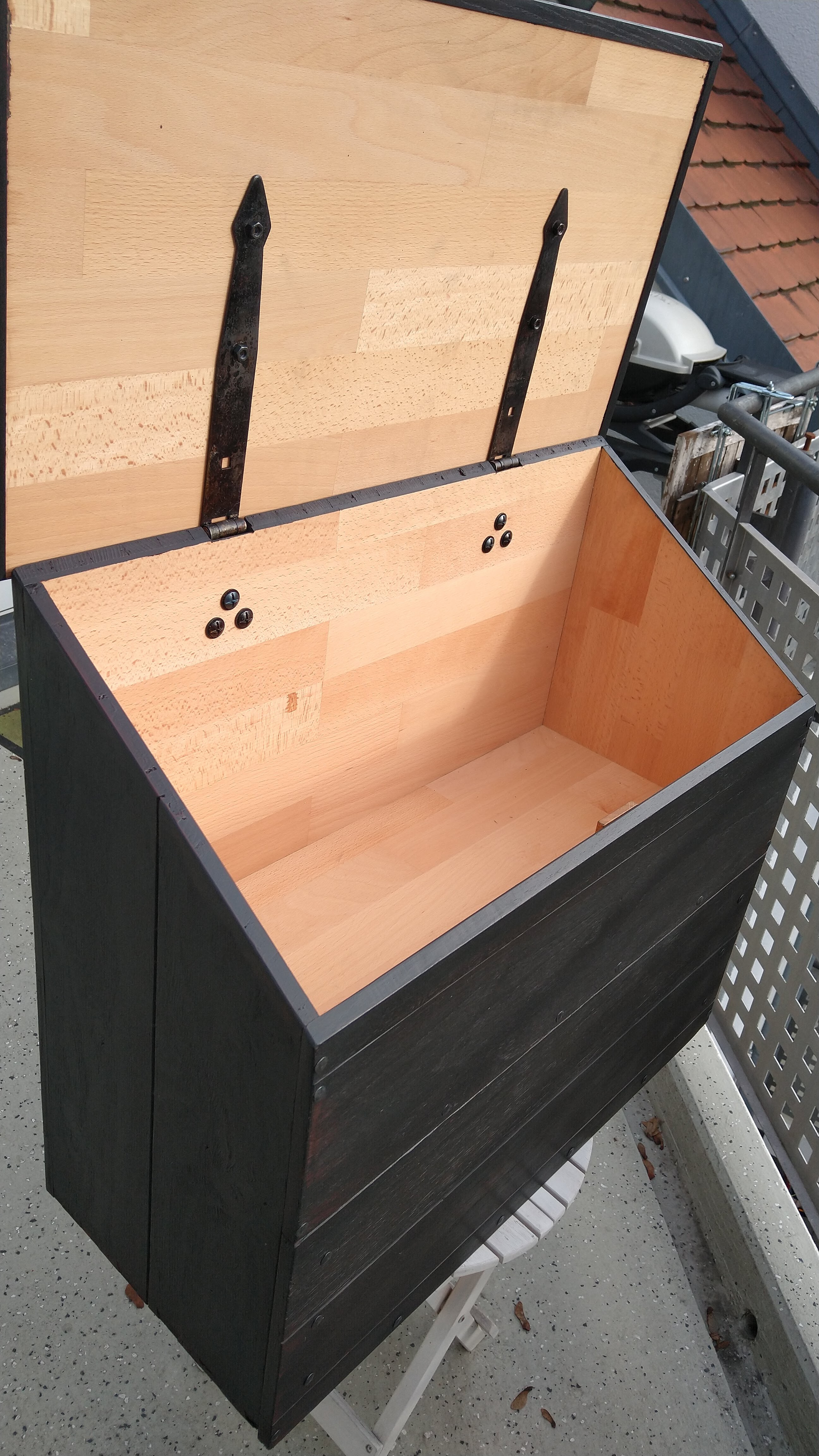
With the hinges installed, this chest is starting to look like it's almost done!

Now it's ready for paint!