I have been experimenting with the burnt wood finish inRaney's article in the April issue of Popular Woodworking. I was interested in watching the Japanese do it. I think they use cedar, and they use a tool very much like a pollissoir.
Wednesday, September 23, 2015
Two Asian Woodworking Videos
The first is a two part series on making a fenced rabbet plane remarkably like the French planes in Roubo. It is in Chinese, which I don't understand, but I bet one could make this plane without understanding the language. I also love his work holding.
It turns out he has a channel, and there are several videos with different projects on it.
The second is in Japanese. I don't understand this language, either.
I have been experimenting with the burnt wood finish inRaney's article in the April issue of Popular Woodworking. I was interested in watching the Japanese do it. I think they use cedar, and they use a tool very much like a pollissoir.
Enjoy.
I have been experimenting with the burnt wood finish inRaney's article in the April issue of Popular Woodworking. I was interested in watching the Japanese do it. I think they use cedar, and they use a tool very much like a pollissoir.

Fingers In the Till - Ratty Old Swedish Jack Plane
This has to be one of the ugliest planes I've ever seen.
Last year while building chairs with Mulesaw in Denmark, Jonas' parents came to visit one day to see all the commotion. Jens also brought along a trunkload of vintage tools from his frequent visits to Sweden. Many of those tools followed me home.
In this pile of tools were a ratty old jack plane, and a somewhat nicer try plane. Both beech, and both with EA Berg double irons.
My intention was to rehab these planes one of these days and see if I could use them. Nothing happened because I like my Veritas BU Jack so much and I never really needed these planes. They sat collecting dust waiting for me to someday get to them.
To make this long story even longer, I have been watching David W.'s series about building a wooden try plane. I wound up with a ginormous slab of quatersawn 12/4 beech the last time I was at the lumberyard, so this project has launched itself in to the "do soon" category.
I have been psyching myself up to build a wooden jack plane, and maybe a try plane because it looks like a fun project. David W. makes a good case for them. Honestly, I really want to try one (get it? "TRY one.").
In the meantime, my list seems to add three projects every time I finish one.
While I was working on tapering some ash legs for a staked desk, I was thinking about the thick shavings I saw on YouTube with that wooden jack.
The other day, I got as far as tapering my foursquare legs to a tapered shape on one leg, and two sides of another before I was worn out with my BU jack. Today I wanted to finish that up, and maybe get some octagonalizing done on them.
I had forgotten about this little wooden jack plane until I saw it when I walked in my shop today. I thought, "Huh! It's too bad I didn't rehab that plane already or I could use it for this project. Perhaps I'll just see if the iron could be sharpened quickly and see what this thing can do."
Instead of that, I gave the iron a couple taps in the mouth of the plane to set it to a course cut to see what it would do.
HOLY CRAP THIS THING CUTS FAST!
Jens must have sharpened this thing before he brought it over for me to look at. I can't believe how well it works.
It feels light, is easy to push, takes incredibly thick shavings with no tear out (unless going really bad against the grain), and made quick work of tapering the rest of the desk legs.
I actually finished the whole job of tapering the rest of the legs without ever taking the blade out to sharpen. I think the double iron forgives a multitude of sins in this matter.
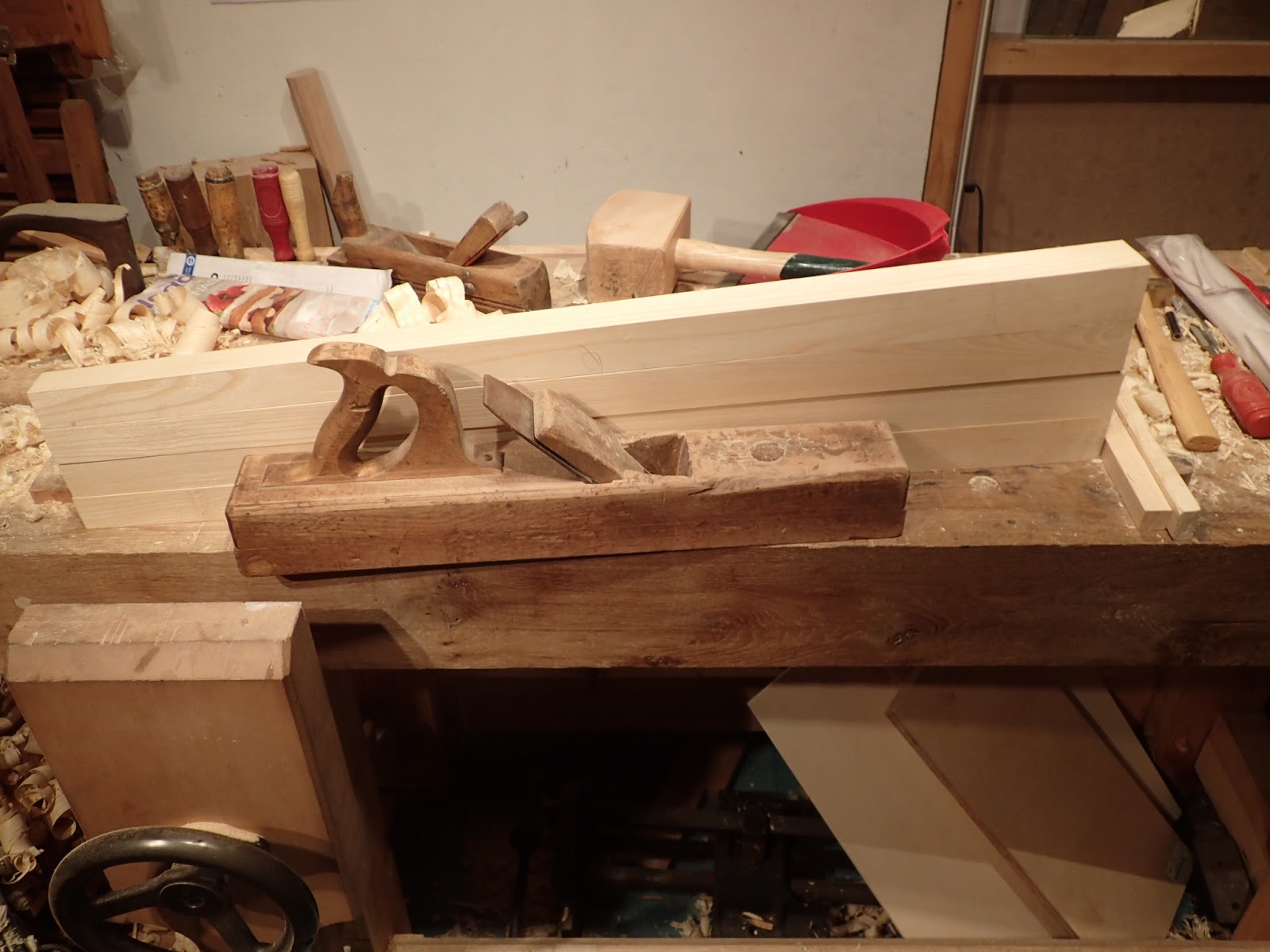
The mouth of this plane is a little different than an English or an American plane. Everything is very triangular, but I suppose it works. The plane is 20 inches long and has a blade 2 1/8 inches wide.
This plane looks like it was made from a rejected piece of firewood. The annular rings go at a 45 degree angle to the plane, rather than quatersawn, like a quality plane would.
The bed looks like someone thought it would be fun to plane a board with a nail in it. Over and over again.
The mouth is wide, as expected, and there is a big chip in the back of the mouth that is just cosmetic. In fact, the whole plane is a cosmetic disaster.
The rest of this plane looks like it fell in a garbage disposal.
I have fallen in love with Swedish steel lately, and was happy to see this Shark logo on the blade.
Cosmetics aside, this plane works well. I was able to finish tapering the desk legs with far less effort than I did with the BU Jack.
Don't get me wrong, I love my BU jack, especially the versatility of the plane. But, this old woodie does the one thing a jack plane should - remove a lot of wood fast. I don't think I would use this one for shooting, or smoothing, jointing or any of the other things that the BU jack does pretty well, but for a single purpose tool, this one nails it.
Just to see if I could do without my BU jack, I got out my old Krenov jack plane to finish the tapers and the octagons.
This plane, unlike the vintage jack, is optimized for very fine shavings. Next time, I'll know better.
It actually makes a good partner with the vintage jack. Rough off the bulk with the rough plane, and this one smooths and joints in one fell swoop. At least good enough for staked legs.
The moral of the story is, if you find an old, ratty jack plane, rather than let it go for firewood or something to screw to the wall at AppleBee's, try it out first. You might be surprised.
 |
| This plane will win no beauty contest. |
 |
| Jens and Jonas. The Swedish Hoarde is on the bench. |
My intention was to rehab these planes one of these days and see if I could use them. Nothing happened because I like my Veritas BU Jack so much and I never really needed these planes. They sat collecting dust waiting for me to someday get to them.
To make this long story even longer, I have been watching David W.'s series about building a wooden try plane. I wound up with a ginormous slab of quatersawn 12/4 beech the last time I was at the lumberyard, so this project has launched itself in to the "do soon" category.
 |
| 12/4 beech on the roofrack of a VW. That's not something you see everyday. |
In the meantime, my list seems to add three projects every time I finish one.
While I was working on tapering some ash legs for a staked desk, I was thinking about the thick shavings I saw on YouTube with that wooden jack.
The other day, I got as far as tapering my foursquare legs to a tapered shape on one leg, and two sides of another before I was worn out with my BU jack. Today I wanted to finish that up, and maybe get some octagonalizing done on them.
I had forgotten about this little wooden jack plane until I saw it when I walked in my shop today. I thought, "Huh! It's too bad I didn't rehab that plane already or I could use it for this project. Perhaps I'll just see if the iron could be sharpened quickly and see what this thing can do."
Instead of that, I gave the iron a couple taps in the mouth of the plane to set it to a course cut to see what it would do.
 |
| A shaving in the mouth. |
 |
| I would break my arm making shavings this thick with my BU jack. |
It feels light, is easy to push, takes incredibly thick shavings with no tear out (unless going really bad against the grain), and made quick work of tapering the rest of the desk legs.
I actually finished the whole job of tapering the rest of the legs without ever taking the blade out to sharpen. I think the double iron forgives a multitude of sins in this matter.
The mouth of this plane is a little different than an English or an American plane. Everything is very triangular, but I suppose it works. The plane is 20 inches long and has a blade 2 1/8 inches wide.
 |
| Here is a view of the mouth. You really can't see anything in this photo. |
 |
| I think you still can't see anything of worth. |
 |
| This one is a little better. |
 |
| Can you see the annular rings? |
 |
| Not pretty. |
 |
| You can even see rays in the grain on the sole! |
 |
| Maybe they thought they could set the wedge with a felling axe? |
 |
| Another glamour shot. |
 |
| If you can see through the rust, there is an EA Berg logo there. |
Don't get me wrong, I love my BU jack, especially the versatility of the plane. But, this old woodie does the one thing a jack plane should - remove a lot of wood fast. I don't think I would use this one for shooting, or smoothing, jointing or any of the other things that the BU jack does pretty well, but for a single purpose tool, this one nails it.
 |
| I used it to taper these legs. |
 |
| I made this Krenov jack plane a couple years ago, but it doesn't get much use. |
 |
| Very fine shavings, indeed! |
 |
| Finished tapered octagonal desk leg. |
Wednesday, September 16, 2015
Irish Chair
My friend John recently made a trip to Ireland with his wife and children to visit family. He sent me this note:
Hi Brian,
I took some photos of a nice Irish chair at my Mother-in-Law's house to share with you!
John
----------------------


 I really like the simple lines of this chair, and the neat ornamentation on the back. Here is my reply to him:
----------------------
----------------------
So how about it, dear readers? Is there anything you notice about this chair? I think it is a neat example of a chair that is still in use after who-knows-how-long.
Hi Brian,
I took some photos of a nice Irish chair at my Mother-in-Law's house to share with you!
John
----------------------


----------------------
Hi John,
Thanks for these pictures!
There are a couple cool things to note about this chair.
First,
it indeed is a true Windsor chair, i.e. a solid seat plank with
everything else growing from that. The legs and spindles all pierce the
seat, probably with a tapered tenon. I bet it's rock solid.
Second,
the seat plank is made up of a single, wide board as opposed to several
narrower boards glued up to make a wide enough plank. I would guess
that this is an indication that the chair is very old. A newer chair
(especially one that was made for the masses as opposed for the wealthy)
would have used a laminated seat blank. It has been a very long time
since it was more economical to save the labor and use a single seat
blank as opposed to now, when the labor is minimal compared to the
expense of a wide board. I wonder what kind of wood it is? It looks
like the seat could be elm or ash, and the arm bow something else like
maple or sycamore, but really they could be anything.
Third,
the legs (especially the front legs) are more upright and pierce the
seat near the edge - this is very much in the English tradition, as
opposed to the Welsh, and John Brown thinks this makes for a very ugly,
blocky look. Who can say, but it was very popular to do that in certain
regions.
If I had to guess, I would say this chair was
made in a factory. The legs and spindles were all turned on a lathe,
and have very simple ornamentation, indicating this is more of an "everyperson's" chair as opposed to a fancy one intended for the rich.
One
of the neat details of this chair is the shaped cutout on the arms
directly in the back. It makes for a nice look, and simplifies the
lamination of the arm bow somewhat, as the joint doesn't have to be
tight or anything, there is a gap that is clearly intended. The crest
is glued on top and holds everything secure. What a neat shape - very
distinctive and unique.
Note that only the front
posts on the arms actually pierce the arm rail. That is because those
take more stress than the other sticks in the back. Often, these posts
are bigger or shaped different than on other chairs for exactly that
reason. I think it interesting that the others don't pierce the arm
rail. It could be that they are just trapped loose in there and aren't
really providing strength. I would have to examine it in person.
The
wedges on all of the piercings go the same direction - left and right.
That is because the grain of the wood goes fore and aft. The wedge
doesn't work to split the wood, it uses the strength of the grain to
hold the tenon tight.
Also, it is normal in the UK for
Windsor chairs to be finished natural, where in the US this type of chair is
painted more often than not.
Is there a story
with this chair? Does your mother in law know how old it is, or how she came by
it? It would be neat to see the underside of the seat. It also would
be neat to see if there is a maker's mark on it anywhere.
Thanks!
Brian
----------------------
So how about it, dear readers? Is there anything you notice about this chair? I think it is a neat example of a chair that is still in use after who-knows-how-long.
Monday, August 31, 2015

Saturday, August 29, 2015
What I've Been Up To
There hasn't been much activity on my blog lately because the Frau and I have been doing a renovation of one of our apartment's rooms. If any of you have had a project like this, I'm sure you know why not much woodworking goes on during this process.
Add on the fact that I have chosen not to spend any vacation hours for this project, and it gets done only during evenings and weekends. That next project is just going to have to wait!
The first thing we did was empty this room - which essentially is what I would call a rec room - of 15 years worth of crap that we've collected. Jeesh! Who knew all that stuff would fit up there?
We hauled about 12 car loads of stuff down to a local storage shed, and probably an equal number of carloads to the dump.
The gross old carpet had to go, too. Unfortunately, it was glued down. Doubly unfortunately, my father-in-law did a particularly good job of gluing it down when he installed it.
Lucky for you, there are no photos of all this.
We laid down a quality underlayment, and used a really nice looking oak parquet. This one has a thin layer of oak on top, a layer of some softwood, probably fir, on the bottom, and a layer of MDF in the middle. Over all, a good looking and (hopefully) stable product.
I have laid several parquet floors in the past, and I usually use my DeWalt 18V circular saw to cut the parquet planks to length when the end of the row is reached. I decided this time I was going to try hand tools, and decided my trusty Dick saw would get the job.
This ryoba saw worked fantastic for this! The kerf is way thinner, so less dust is generated. Plus, the sawdust doesn't fly all over the room like with my power tools. Less noise, so the building's strict noise policy is not violated, and I think it really is no slower than using the power saw.
The only time I got a power tool out was the jigsaw, which I chose to use for the rip cuts.
Overall, the floor came out meeting our expectations.
The next step is we have some built-ins being custom made for this room, then fill them up with all the crap we have in storage. The idea is this room will look nice rather than just collect all of the stuff that doesn't have a place to be put away.
Add on the fact that I have chosen not to spend any vacation hours for this project, and it gets done only during evenings and weekends. That next project is just going to have to wait!
The first thing we did was empty this room - which essentially is what I would call a rec room - of 15 years worth of crap that we've collected. Jeesh! Who knew all that stuff would fit up there?
We hauled about 12 car loads of stuff down to a local storage shed, and probably an equal number of carloads to the dump.
The gross old carpet had to go, too. Unfortunately, it was glued down. Doubly unfortunately, my father-in-law did a particularly good job of gluing it down when he installed it.
Lucky for you, there are no photos of all this.
 |
| But here is one of the room after the carpet came out. |
 |
| One of the challenges was there are two cubby holes like this in the room. |
This ryoba saw worked fantastic for this! The kerf is way thinner, so less dust is generated. Plus, the sawdust doesn't fly all over the room like with my power tools. Less noise, so the building's strict noise policy is not violated, and I think it really is no slower than using the power saw.
The only time I got a power tool out was the jigsaw, which I chose to use for the rip cuts.
 |
| Here is the toolkit I used to install the floor. |
 |
| We like how it looks. |
Is It Possible to Make Your Own Chisels?
I intend to find out!
One of the guys on Instagram made a set of chisels from O1 tool steel very similar to the steel I used for my French style moulding planes. I was thinking about making some chisels from this stuff, and went so far as to order some steel in 1/4" thickness for exactly this purpose. The toolmaker on Instagram inspired me to go for it.
My plan is to make some firmer chisels, tanged with some kind of octagonal handles. I thought that my J. Jowett chisels would be good ones to model.
The heaviest part of these chisels is near the handle, and the thickness tapers off to roughly half the thickness at the business end. After looking at my other firmer chisels, I find that this shape is fairly standard.
On my way out the door the other day, I couldn't be bothered to dig for my J. Jowett chisels, so I grabbed a rusty beater firmer chisel from the above pile on my bench. It is a Jernbolaget, and needs some serious rehab, but has the right shape.
To grind the shape on the un-hardened tool steel, I made the decision that I needed some kind of belt grinder for major waste removal. There happened to be a cheap Chinese belt sander at the local grocery store for 29.99 Euros. Perfect, just in case this ruins the tool. I don't really see myself needing this for woodworking.


The steel blank is 18" long, plenty to make two chisels. In fact, the bench chisel I am making uses only about 8" of the blank, so if this works, I should come away with a set of longer paring chisels as well.
My plan is to heat treat and finish this chisel to see if it works before I spend a bunch of labor on the whole set. I think I may grind the longer side of this chisel blank too, before I cut it in half. It seems to be easier to hold on the grinder that way.
One way or another, I will post on the finished project when I get it done.
One of the guys on Instagram made a set of chisels from O1 tool steel very similar to the steel I used for my French style moulding planes. I was thinking about making some chisels from this stuff, and went so far as to order some steel in 1/4" thickness for exactly this purpose. The toolmaker on Instagram inspired me to go for it.
My plan is to make some firmer chisels, tanged with some kind of octagonal handles. I thought that my J. Jowett chisels would be good ones to model.
 |
| I like these chisels, and hope mine turn out as nice. |
 |
| I think I might have a problem. This is my latest pile of Swedish chisels. |
To grind the shape on the un-hardened tool steel, I made the decision that I needed some kind of belt grinder for major waste removal. There happened to be a cheap Chinese belt sander at the local grocery store for 29.99 Euros. Perfect, just in case this ruins the tool. I don't really see myself needing this for woodworking.
 |
| Here is my setup on the balcony for using this as a belt grinder. It came with the clamps and seems to be sturdy enough. |
I found that this works relatively quickly with a 40 grit belt installed. I use a wooden batten for stability and a little pressure, and move it back and forth from the tip of the chisel blank to the back of where I want the taper to stop. This makes a nice taper of just about the shape I want.

It probably took 15 or 20 minutes on this 3/4" wide blank. The chisel in the photo is the Jernbolaget that I used as a reference.

The steel blank is 18" long, plenty to make two chisels. In fact, the bench chisel I am making uses only about 8" of the blank, so if this works, I should come away with a set of longer paring chisels as well.
My plan is to heat treat and finish this chisel to see if it works before I spend a bunch of labor on the whole set. I think I may grind the longer side of this chisel blank too, before I cut it in half. It seems to be easier to hold on the grinder that way.
One way or another, I will post on the finished project when I get it done.
Wednesday, August 5, 2015
June Chair Build - Finished in the Nick of Time
Another day or two, and I wouldn't have finished this chair in June!
All kidding aside, I'm glad I took the extra time to do this chair properly. Although it isn't perfect, I am very pleased with the shape and I learned a lot. Mostly thanks to Peter Galberts' book.
Here are a few pics of the last part of the build. The first is of the wedged leg from the top of the seat. I wound up reaming the holes quite a bit larger than the 5/8" which is usual. I did this because I felt it made for a stronger joint, which I think was necessary due to the extreme splay and rake of the legs.
There is a little spring to this chair. The legs tend to splay a little more when you put your weight in it, but it feels solid to the sitter. The back springs a little, too. I'll let you know if anything ever breaks.
I used a block plane to chamfer the feet. This chair will live on a wooden floor, so the intent is to put some felt protectors on the feet to avoid scratching anything. I have only ever had good luck with the felt protectors that you nail in. The sticky-tape ones tend to come off over time, and the next set doesn't stick as well as the last.
Here is a pic of the chair while dry-fitting the back. This was the first time I got to see the whole chair together in one piece. All that was left from this point was to figure out how to permanently attach it. I decided to wedge everything.
Here is how I did the blind wedges: I cut some wedge stock from some scrap mahogany I had laying around (it was the right width). I sawed a kerf in the end of the stick a little less than the depth of the mortise. I placed the wedge loosely in the kerf with glue on one side, slopped glue around the end of the stick that will enter the mortise, and beat the crap out of it with a mallet.
The idea is the wedge will force the ends of the stick in the mortise apart a bit making the joint tighter the farther it is driven in.
This went relatively smoothly. To drive the sticks, I didn't clamp it in my face vice, I clamped the crest upside down on my bench to my planing stop.
For the bottom, I used through mortises and was able to drive wedges after the sticks were in place. Once I did this, I flush cut them so they wouldn't be visible when looking at the chair.
And that's it! This chair really wouldn't take too long to make if one was able to spend a few days uninterrupted. The reason for me was I had not much time to do woodworking during this project, I had breaks of a week or so between shop sessions. Even so, this project didn't really take THAT long. I recommend a chair in this style to any aspiring chair maker.
I'll soon post some more glamour shots of the chair, along with some of the more technical aspects of it and the build.
 |
| Chair is done. |
Here are a few pics of the last part of the build. The first is of the wedged leg from the top of the seat. I wound up reaming the holes quite a bit larger than the 5/8" which is usual. I did this because I felt it made for a stronger joint, which I think was necessary due to the extreme splay and rake of the legs.
 |
| Fumed oak leg with an elm wedge in the elm seat. |
 |
| Small chamfer on the feet. |
Here is a pic of the chair while dry-fitting the back. This was the first time I got to see the whole chair together in one piece. All that was left from this point was to figure out how to permanently attach it. I decided to wedge everything.
 |
| Dry fit of the back. |
 |
| Shortly before being driven into the mortise. I did actually trim this wedge a little shorter right after this photo. |
 |
| Imagine glue everywhere. |
 |
| Driven home. |
 |
| Through mortises for the sticks in the seat. |
 |
| The finished chair. |
Subscribe to:
Posts (Atom)